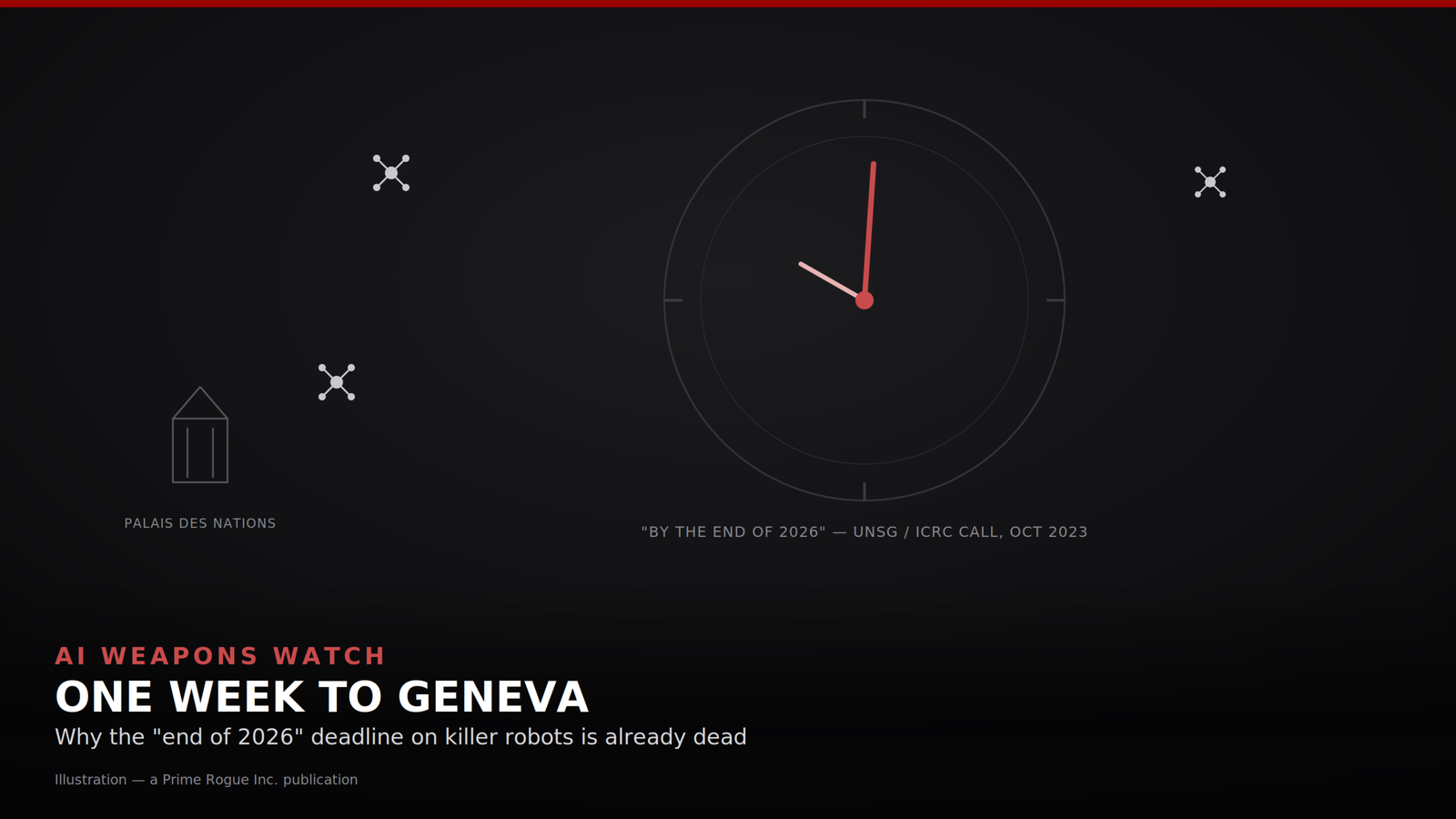
The clock the UN Secretary-General and ICRC set in 2023 for a binding autonomous-weapons treaty runs out this year. One working session remains. Illustration: AI Weapons Watch / Prime Rogue Inc.
One Week to Geneva: Why the “End of 2026” Deadline on Killer Robots Is Already Dead
The UN’s autonomous-weapons experts reconvene August 31. The battlefield evidence this outlet has spent the year documenting will not be on the agenda — and the diplomats know it.
AI Weapons Watch | Kevin J.S. Duska Jr. | August 23, 2026
A Session Almost Nobody Is Covering
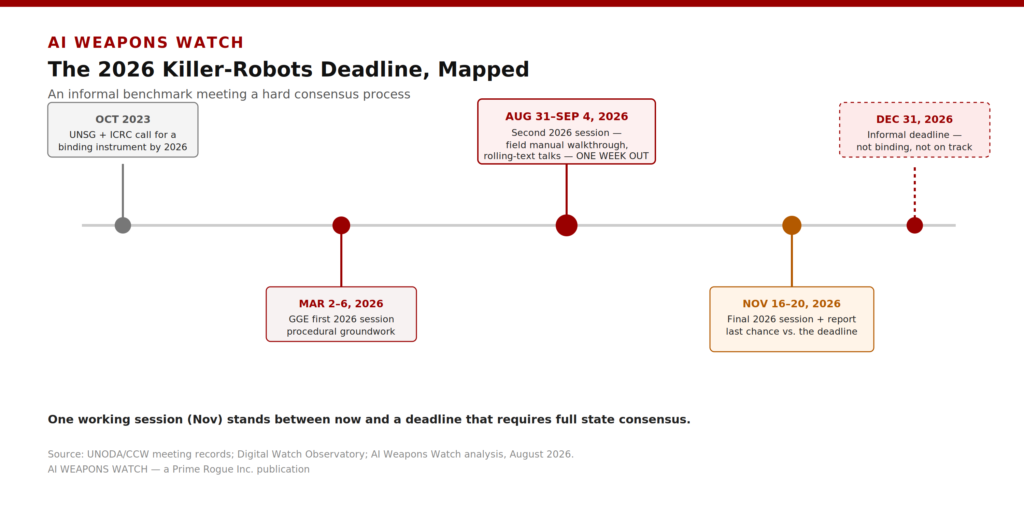
On August 31, the United Nations’ Group of Governmental Experts on Lethal Autonomous Weapons Systems reconvenes at the Palais des Nations in Geneva for its second 2026 session, running through September 4 under the continued chairmanship of Robert in den Bosch of the Netherlands. It is the kind of meeting that produces almost no headlines and almost all of the actual groundwork on a question this outlet has spent the year documenting from the other direction: whether any human is left making the decision when an autonomous weapon kills someone. The GGE’s first 2026 session ran March 2–6. Its next, and likely decisive, session for the year is scheduled for November 16–20, also in Geneva. Between those dates sits a deadline that has quietly become the most-cited, least-binding number in this entire policy space.
That number is “by the end of 2026.” It comes from a joint call the UN Secretary-General and the President of the International Committee of the Red Cross first issued in October 2023, urging states to conclude a legally binding instrument on autonomous weapons systems by that date. It has been repeated at nearly every GGE session since. It appears in NGO literature, academic briefings, and diplomatic remarks as though it were a treaty obligation. It is not. It is an aspiration two unelected international officials attached to a process that requires consensus among states that fundamentally disagree about what they are even trying to regulate — and with five months left on the clock and one working session standing between now and the deadline, the honest assessment is that it will not be met.
The Deadline That Became a Ritual
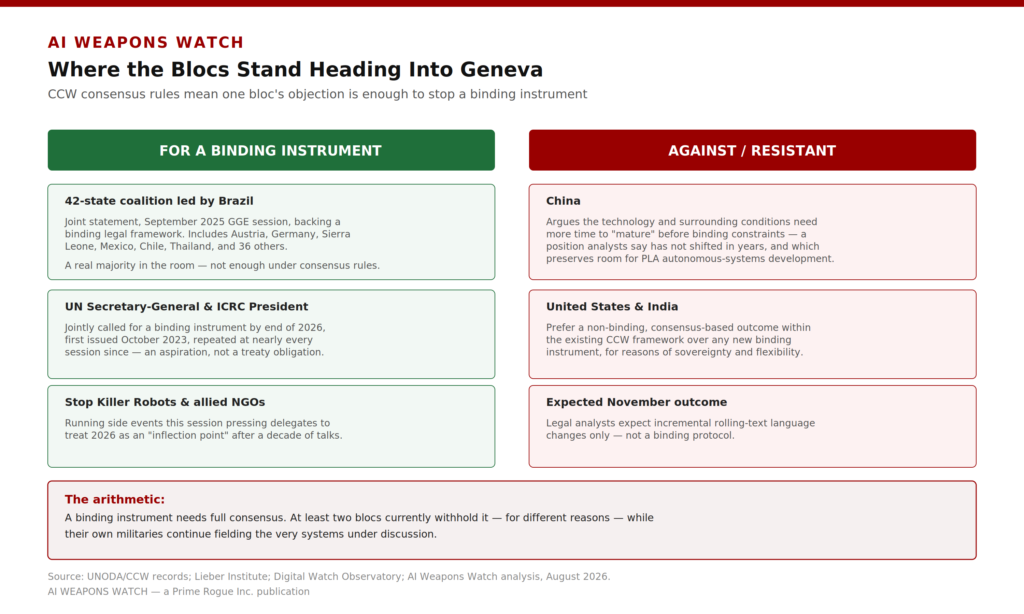
None of this is a secret among the people who attend these sessions, which is precisely why it deserves more attention outside them. The GGE was created in 2016. It spent 2025 working through sessions in March and September toward what many participants hoped would be a Seventh Review Conference breakthrough. In September 2025, Brazil delivered a joint statement on behalf of 42 states, including Austria, Germany, Sierra Leone, Mexico, Chile, and Thailand, explicitly backing the development of a binding legal framework. That is a real coalition, and it is larger than the group of states actively resisting one. It is also, under the CCW’s consensus rules, not enough. A single major power’s objection is sufficient to prevent any binding outcome, and more than one major power is objecting.
China’s position, according to analysts who track the GGE closely, has not meaningfully shifted in years: Beijing argues the technology and the conditions surrounding it need more time to mature before any state should accept binding constraints, a stance that conveniently preserves room for the People’s Liberation Army’s own autonomous-systems development while sounding like caution rather than obstruction. The United States and India, for different reasons, continue to prefer a non-binding, consensus-based outcome within the existing CCW framework over a new binding instrument altogether. The most likely product of the November session, according to people who study this process for a living, is incremental language changes to an existing rolling text — modest concessions on how “human judgment” gets defined — rather than anything that would bind a single state’s battlefield conduct.
What the Diplomats Won’t Be Discussing
The gap between the Geneva agenda and the year this outlet has covered is not subtle. In August, a Ukrainian account surfaced describing a drone swarm near Chasiv Yar that reportedly severed its own data link and killed Russian soldiers with no human in the final decision — a claim Kyiv has not confirmed, consistent with its own stated CCW position, but one this outlet assessed as a watershed regardless of confirmation status. In April, President Zelenskyy announced Ukrainian forces had captured a Russian position “exclusively by unmanned platforms,” a remotely piloted rather than autonomous operation, but one built on a program that scaled from roughly 2,000 to more than 22,000 frontline missions in months — growth that creates exactly the operational pressure toward autonomy that a jammed communications link makes attractive. Ten days after that announcement, the chairman of the U.S. Joint Chiefs called autonomous weapons “a key and essential part of everything we do,” three months after his own department told AI vendors their models could be deployed for “any lawful use” and pressed at least one major AI company to drop safeguards against fully autonomous weapons use.
None of that is on the GGE’s formal agenda, and none of it needs to be for the session to matter — the point is what the session’s pace reveals when set beside it. The Geneva process was designed for a world where states move first and machines follow. What this outlet has documented all year is closer to the reverse: battlefield units and defense ministries adopting capability under operational pressure, with doctrine and diplomacy arriving afterward to describe what already happened rather than constrain what happens next.
The Field Manual: Real Value, Modest Reach
The most substantive product likely to come out of the Geneva session is not a treaty text but a field manual — a catalogue of realistic operational scenarios in which lethal autonomous weapons could be deployed across air, land, and sea, paired with guiding questions meant to help state legal advisers apply existing international humanitarian law to each one. A side session this week will walk delegates through its scope and structure, and a coalition including the advocacy group Stop Killer Robots is using the same week to press for what it calls the decade of work at the CCW finally producing action rather than another rolling text.
A field manual is a genuinely useful document, and this outlet does not want to undersell it: legal advisers in ministries of defense around the world will use something like this to reason through edge cases that current doctrine does not clearly address. But a catalogue of scenarios paired with guiding questions is an interpretive aid, not a rule. It tells a state’s lawyers how to think about a system already fielded. It does not tell any state it may not field one. The distance between “here is how to think about this” and “you may not do this” is the entire distance this process has failed to close in ten years of trying.
- March 2–6, 2026: GGE’s first 2026 session, Geneva — procedural and thematic groundwork.
- August 31–September 4, 2026: Second 2026 session — field manual walkthrough, continued rolling-text negotiation.
- November 16–20, 2026: Final 2026 session and GGE report — the last realistic chance to meet the informal “end of 2026” benchmark.
- Ongoing: A 42-state coalition led by Brazil backs a binding instrument; China, the U.S., and India each prefer weaker or non-binding paths, for different reasons.
Why the Math Doesn’t Work
Strip away the diplomatic language and the arithmetic is straightforward. A binding instrument requires consensus. At least two significant blocs, China on maturity grounds, the U.S. and India on sovereignty and flexibility grounds, currently oppose one. A single working session in November, however well-prepared, is not enough time to reverse a position multiple states have held consistently across years of GGE meetings, particularly not while each of those states’ own militaries are simultaneously accelerating the fielding of the exact systems under discussion. The Lieber Institute‘s own analysts, watching this process from inside the legal academy that feeds it, expect “incremental tweaks to the rolling text” in November and nothing that meaningfully challenges the status quo. This outlet sees no reason to disagree with that read.
What tends to get lost is that this is not a story about bad faith so much as a story about mismatched clocks. The CCW process moves at the speed of sovereign consensus, which is slow by design — that slowness is a feature when the alternative is a hasty treaty nobody actually complies with. Battlefield adoption of autonomous and semi-autonomous systems moves at the speed of operational necessity under fire, which is about as fast as an institution can move. Those two clocks were never going to run at the same pace, and the “end of 2026” deadline was always a bet that diplomatic urgency could catch up to battlefield urgency in three years. It hasn’t, and one week out from the session that was supposed to be the penultimate step toward closing that gap, there is no realistic path left for it to.
Closing Assessment
The Geneva session convening August 31 deserves credit for what it actually is: careful, consensus-bound, legally serious work by people who take the stakes seriously and are trying to build something durable rather than something fast. That is not a small thing, and it is not this outlet’s place to mock diplomats for doing diplomacy at the pace diplomacy requires. But readers who have followed this outlet through Chasiv Yar, through April’s unmanned capture, through Gen. Caine’s remarks, are entitled to hold both facts at once: the process built to prevent a runaway autonomous-weapons future is arriving at its own self-imposed deadline having produced a field manual and a rolling text, while the capability that manual is meant to help lawyers reason about has already been fielded, tested, and in at least one reported case, used to kill without anyone reviewing the shot. The deadline was never going to save anyone by itself. The question worth asking in Geneva this week is not whether “end of 2026” will be met. It won’t. It’s what happens to the argument for binding rules once even its own advocates stop pretending otherwise.
The opinions put forth herein reflect the intelligence analysis conducted by AI Weapons Watch’s administrator – Prime Rogue Inc.
About the Author