AI Weapons Watch, a Prime Rogue Inc. / Signal Cage intelligence vertical — this edition: automation bias, the Patriot fratricides, and the human-authorization hinge in AI targeting.
Automation Bias: Why “Human-in-the-Loop” Doesn’t Always Mean What You Think
AI Weapons Watch | Kevin J.S. Duska Jr. | August 4, 2026
Every AI weapons system on Earth claims to keep a human “in the loop.” The Patriot missile system made the same claim in 2003, on paper, right up until it shot down two friendly aircraft. This is what automation bias actually is, how it killed people two decades before Project Maven existed, and why it’s the real vulnerability sitting underneath every modern targeting pipeline.
A Term Psychologists Coined, and the Military Proved
Automation bias is a term from human-factors psychology, not military doctrine, and that origin matters. Researchers studying aviation and process-control cockpits in the 1990s defined it as the tendency of a human operator to favor a machine’s suggestion over their own judgment, even when contradictory information is available, and even when the human is nominally responsible for the final call. It shows up in two related failure patterns: errors of omission, where a person fails to notice a problem because the automated system didn’t flag it, and errors of commission, where a person follows an automated recommendation that is actively wrong, without independently verifying it.
The concept did not stay confined to psychology journals. It was picked up by human-factors researchers working on air-defense systems in the early 1990s, who warned, years ahead of the fact, that fielding highly automated weapons systems in “automatic” or near-automatic modes would predictably produce exactly this failure pattern under combat stress. That warning was not hypothetical for long.
Two Fratricides in Five Days
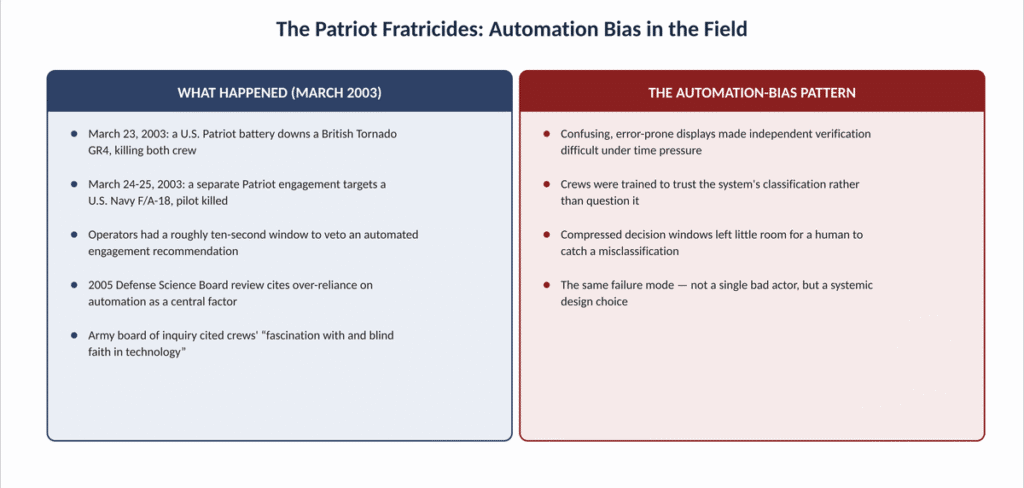
In March 2003, during the opening days of Operation Iraqi Freedom, a U.S. Army Patriot battery engaged and destroyed a British Royal Air Force Tornado GR4 returning from a strike mission, killing both crew members. A day later, a separate Patriot unit locked onto and engaged a U.S. Navy F/A-18, killing its pilot. Out of eleven ballistic-missile engagements Patriot batteries conducted during that period, two were fratricides — a failure rate that triggered a formal Pentagon investigation and a multiyear Army human-factors review.
The details that came out of that review are the reason this incident still gets cited in automation-bias literature more than two decades later. Patriot’s identification-and-engagement software was operating in a highly automated mode, and operators were typically given something on the order of ten seconds to review and veto a system-generated engagement recommendation before it executed. The system’s displays were, by multiple accounts, confusing and occasionally wrong. Crews had been trained, organizationally and culturally, to trust the system’s classification logic rather than second-guess it under time pressure. The Army’s own board of inquiry did not mince words, describing the culture around the system as amounting to blind faith in the technology.
None of this means the operators were careless or poorly trained in the ordinary sense. That is precisely the point automation-bias researchers make: this is a predictable, structural failure mode that emerges from the combination of compressed decision time, imperfect displays, and organizational trust in a system, not a character flaw in the individual sitting at the console. The same conditions will reliably produce the same outcome with different personnel, different training, and different hardware, unless the underlying decision architecture changes – in the context of Project Maven and other AI weaponization initiatives.
From Missile Defense to AI Targeting
Patriot’s automation in 2003 was rules-based radar-track classification, not machine learning, and it is worth being precise about that distinction. But the human-factors problem it exposed transfers directly, and arguably gets worse, as targeting systems move from rules-based logic to machine-learning models making probabilistic recommendations. A modern AI-enabled targeting pipeline — the kind now used to sort intelligence feeds and propose target packages to human commanders — reproduces the exact same architecture that failed twice in five days in 2003: a machine generates a recommendation, a human is given a narrow window to accept or reject it, and the system’s design, training, and organizational culture all push toward acceptance rather than scrutiny.
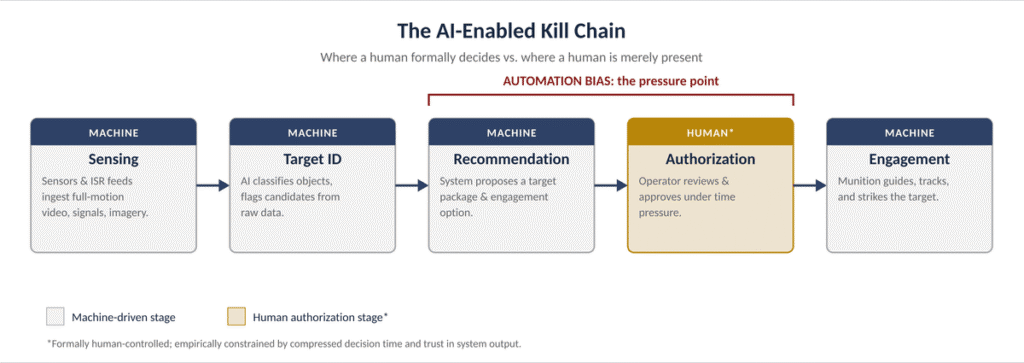
The bracketed stage in the diagram above — the point where a system’s recommendation becomes a human’s authorization — is not a detail. It is the entire hinge on which the legal and ethical case for AI-assisted lethal force rests. Every claim that a system keeps “a human in the loop” is implicitly a claim that this hinge holds under real operational pressure. Patriot’s own program documentation made that claim too.
Why Speed Makes the Problem Worse, Not Better
The instinct in most weapons programs is to treat automation bias as a training problem — something a better interface or a stricter protocol can fix. That instinct runs directly into the opposite institutional pressure: every generation of targeting technology is being built to compress decision time further, not preserve it, because speed is the entire selling point against a faster-moving adversary. A coordinated drone swarm multiplies the number of simultaneous engagement decisions a single operator is nominally supervising, which mathematically shrinks the genuine attention available per decision even if the nominal review window stays the same.
Extend that same compression to the state level and you get the scenario known as flash war: automated sensing and response systems on opposing sides interacting at machine speed, with human decision-makers structurally too slow to intervene before an escalation sequence completes. Automation bias is the mechanism that makes flash war plausible rather than purely theoretical — it is the reason a human overseeing a fast-moving automated system is likely to defer to it rather than override it, even at the strategic level, even when the stakes are catastrophic rather than tactical. With AI alignment being impossible, this makes the problem significantly worse.
Kargu-2 and the Same Failure Mode, Exported
What Would Actually Address It
The Patriot case produced concrete recommendations that are worth restating because most of them remain only partially implemented across the newer generation of AI-enabled systems now being fielded.
- Decision time as a protected resource. Review windows should be sized to genuine human cognitive capacity for the specific decision, not compressed by default to whatever the technology permits.
- Interface design that surfaces uncertainty. A system that presents a recommendation with visible confidence intervals and conflicting signals invites scrutiny; a system that presents a clean, confident answer invites automation bias by design.
- Independent verification channels. Patriot crews had no easy way to cross-check the system’s classification against an independent source in real time; any targeting architecture should preserve at least one channel that is not derived from the same sensor and model chain being reviewed.
- Training that rewards override, not compliance. Organizational culture that treats vetoing the machine as a career risk will reliably produce operators who don’t veto the machine — that incentive structure has to be built deliberately in the other direction.
- Honest public claims about what “human-in-the-loop” means. A veto window that is structurally too short for genuine review is not meaningful human control, and program documentation that calls it that either misunderstands the research or is not being straight about it.
None of these fixes are exotic or unknown. They were largely already understood by human-factors researchers before the Patriot fratricides happened, which is the most uncomfortable part of the story — the failure mode was predicted, in writing, more than a decade in advance, and the prediction was not acted on until after people died. The current generation of AI-enabled targeting and defense systems is now running the same experiment at a larger scale and a faster clock speed. Whether the lesson gets applied proactively this time, or only after the next Patriot-style incident, is an open institutional question rather than a technical one.
AI Weapons Watch is powered by, and under the editorial control of Prime Rogue Inc
About the Author