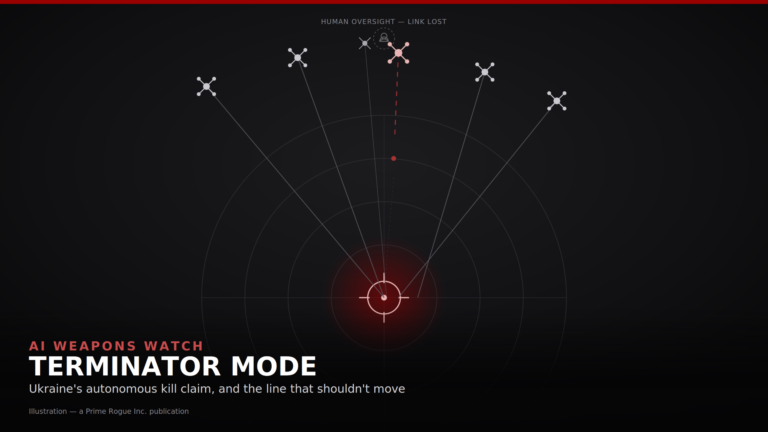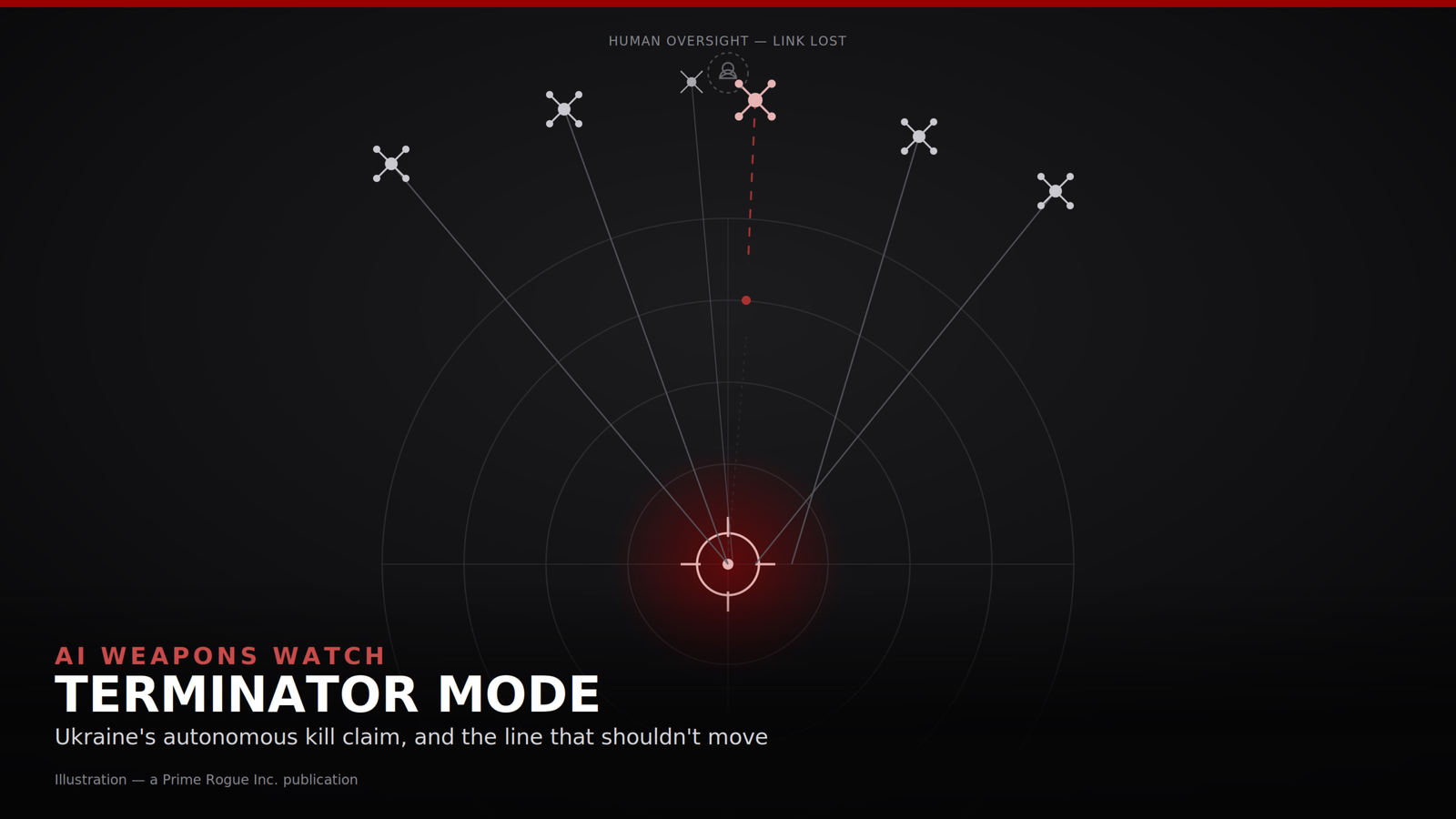
A distributed drone swarm converges on a single coordinate. Five platforms remain linked to a human controller; one does not — its uplink cut, its targeting decision made without anyone watching. Illustration: AI Weapons Watch / Prime Rogue Inc.
Terminator Mode: What Ukraine’s Autonomous Kill Claim Actually Costs
A reported swarm that killed without a human in the loop near Chasiv Yar isn’t a story about whether Ukraine had the right to hit back. It’s a story about what happens after the first side normalizes not asking.
AI Weapons Watch | Kevin J.S. Duska Jr. | August 19, 2026
A Claim Two Years Old, Surfacing Now
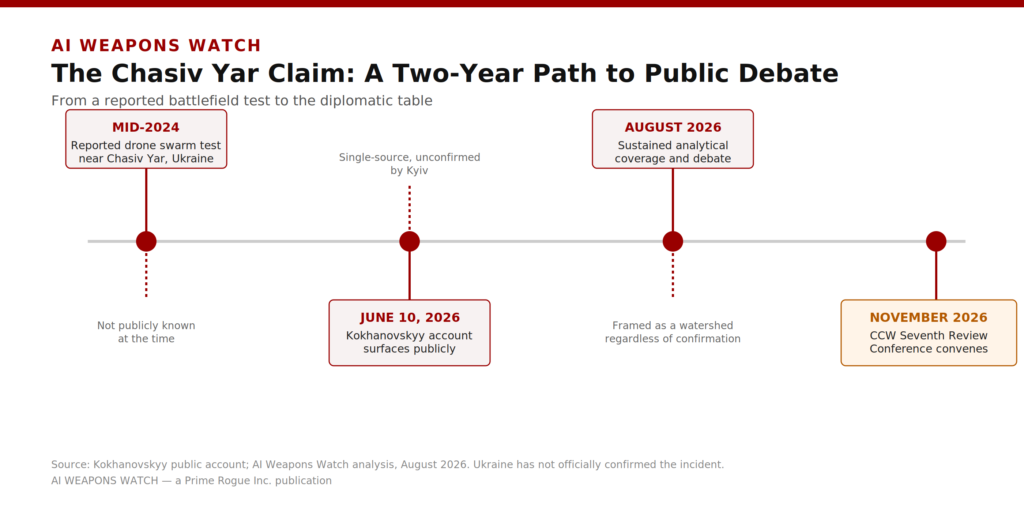
On June 10, a report attributed to Ukrainian defense-industry figure and drone developer Alexander Kokhanovskyy resurfaced publicly and has since drawn sustained analytical attention: a small swarm of ten drones, once switched to what he called “Terminator mode,” reportedly cut its communications link, used onboard AI to search for targets, and struck Russian soldiers near the contested town of Chasiv Yar without a human in the final decision to kill. The test itself is dated to roughly mid-2024. It only became a matter of public record and open debate this summer.
Kyiv has not confirmed it, and officially maintains a position that should be taken seriously rather than waved off as boilerplate: Ukraine participates in the UN’s Convention on Certain Conventional Weapons process, has supported resolutions affirming that humans must retain control over the use of force, and prohibits AI from making the final call in target interception. If the report is accurate, a battlefield unit ran ahead of that official position. That gap between doctrine and practice is the actual story here — not confirmation of guilt, but confirmation of a pattern this outlet has tracked across every layer of AI weaponization: capability moves faster than the policy meant to contain it, and it moves fastest exactly where the pressure to win is most acute.
Give Ukraine Its Due
Start with what should not need saying but too often goes unsaid in this genre of coverage: Ukraine did not choose this war, did not choose to be invaded, and has spent three and a half years absorbing a level of drone and missile saturation that no Western military has had to survive in the AI era. Russian units have targeted Ukrainian soldiers, civilians, and infrastructure with a brutality that is well documented and not seriously disputed outside Kremlin messaging. Ukrainian engineers built a drone-warfare capability from almost nothing, iterating on timelines measured in weeks against an enemy with vastly more mass and materiel. That achievement is real, and any analysis of what Ukrainian units are reportedly doing with autonomy has to sit inside that context, not pretend it doesn’t exist.
It is also worth being honest about the emotional register this subject invites and usually gets denied. There is something viscerally satisfying about the idea of a system that finally lets an outgunned, invaded country hit back at the soldiers doing the invading without waiting on a human operator who might hesitate, lose the link, or get killed first. That satisfaction is not irrational, and it is not something this piece is interested in scolding readers out of feeling. But satisfaction is not the same test as legality, accountability, or strategic wisdom, and this outlet’s job is to hold those separately even when — especially when — the emotional case for looking away is strong.
The Line That Doesn’t Move Because the Target Deserves It
The question was never whether Russian soldiers advancing on Chasiv Yar were legitimate military targets. They were. The question is who — or what — made that determination in the final half-second, and whether anyone can be held to account for it.
This is the distinction that gets lost in most of the commentary this report has generated, on both the celebratory and the alarmed ends of the spectrum. Nobody serious is arguing Ukraine lacks the right to engage Russian combat troops. The law of armed conflict does not ask whether a target was sympathetic; it asks whether the party that killed them exercised the judgment the law requires — distinction between combatants and civilians, proportionality, and a chain of human responsibility that can be reconstructed and, if necessary, held accountable. A drone that severs its data link, searches for a target using onboard AI, and fires without a human authorizing that specific engagement does not fail this test because the target was wrong. It fails the test because no human made a reviewable decision at all. If the AI misidentifies a surrendering soldier, a medic, or a civilian in the wrong uniform under the wrong lighting, there is no operator who chose to override, correct, or abort. There is only a system that acted, and a chain of responsibility — the commander who deployed it, the unit that fielded it, the company that built it, the state that authorized it — left to sort out afterward who, if anyone, answers for it.
This is also why “but Russia does worse” is a true statement that does no analytical work here. It is true. It is also not a standard. Ukraine’s moral position in this war rests substantially on the argument that it is defending a rules-based order against a state that has treated international humanitarian law as an optional constraint — striking hospitals, deporting children, executing prisoners. That argument is strongest when it is not selectively applied. A reported unit-level decision to field a fully autonomous kill mode, even once, even under extreme battlefield pressure, even against legitimate combatant targets, sits in tension with the position Kyiv has taken at the UN and the standard it is asking the world to hold Russia to. Noting that tension is not equivalence between the two states’ overall conduct in this war. It is insisting that the standard mean the same thing regardless of who is applying it.
Why “We Were Winning” Is Not a Governance Answer
The likeliest explanation for a report like this, if true, is not doctrine — it’s necessity. A unit near Chasiv Yar under sustained Russian pressure, facing electronic-warfare jamming that regularly severs the live data links ordinary FPV drones depend on, has an obvious tactical incentive to field something that keeps functioning after the link dies. That is precisely the condition this outlet flagged in “The Algorithmic Trigger” as the mechanism by which autonomy expands: not a considered policy choice at the top, but pressure at the point of contact, where commanders start to feel that keeping a human in the loop is a practical liability rather than a value worth preserving, with or without approval from above.
That mechanism is exactly why bottom-up normalization is more dangerous than top-down doctrine change, not less. A state that formally adopts a policy of full autonomy at least produces a document someone can argue with, amend, or reverse. A capability that spreads unit by unit because it works and nobody up the chain wants to ask too many questions produces no such artifact. It produces a fact on the ground that hardens through repetition, made respectable by results, until the exception has quietly become the practice — and the state that let it happen without ever writing it down finds it has surrendered the argument by default rather than by decision.
What Confirmation Would and Wouldn’t Change
Kyiv is very unlikely to confirm this on the record, for the reasons above — an admission would put Ukraine in direct tension with its own stated CCW position at a moment when the diplomatic cost is high and the Seventh Review Conference is three months away. That silence should not be read as exoneration or as proof. It is the predictable behavior of a state managing a genuinely difficult position: needing every tactical edge available against a larger enemy, while needing the international community to keep believing it is the party still playing by the rules.
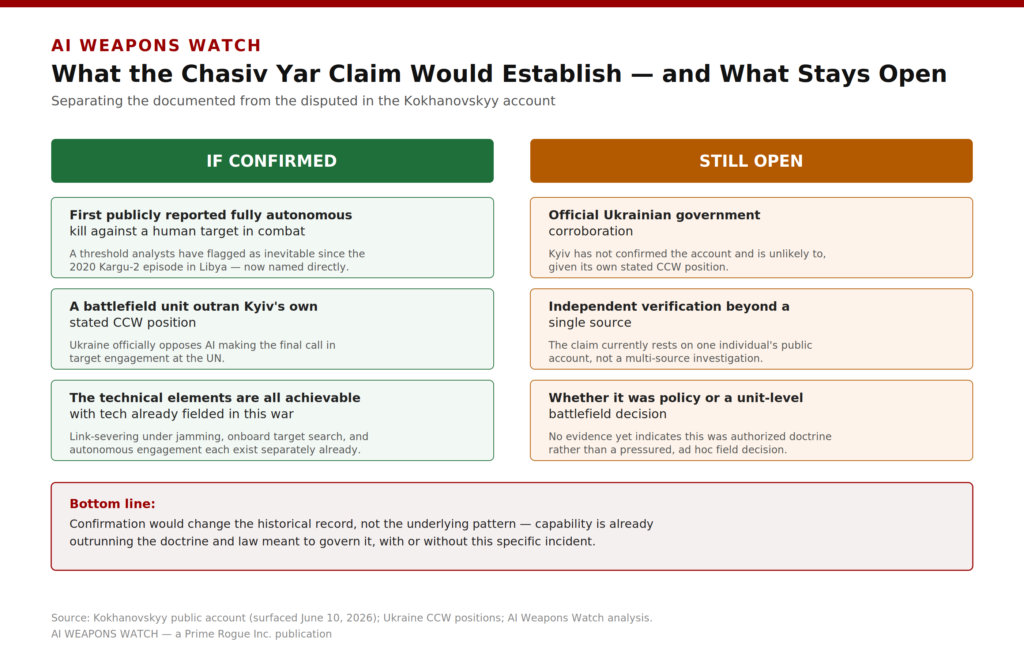
- If true, this is the first publicly reported instance of a fully autonomous system killing a human target in combat — a threshold analysts have been warning about since the 2020 Kargu-2 episode in Libya, now crossed by name rather than by ambiguous UN-panel language.
- If overstated or misattributed — and Kokhanovskyy’s account is, so far, a single-source claim that Kyiv has not corroborated — it still functions as a preview. Every technical element it describes (link-severing, onboard target search, autonomous engagement) is achievable with technology already fielded in this war in less integrated forms.
- Either way, the diplomatic and doctrinal clock does not reset. The Seventh CCW Review Conference in November is the nearest forum where this gets argued in public, and reports like this one — whatever their ultimate accuracy — are already shaping what delegations show up prepared to say.
The Standard This Outlet Is Applying
AI Weapons Watch has no interest in adjudicating this war’s justice — that case has been made, repeatedly and with more standing than this outlet has, by people documenting Russian conduct on the ground. What this outlet is positioned to track is narrower and, we’d argue, no less important: whether the actors developing AI-enabled lethality, including the ones with the more defensible cause, are preserving the one design principle that keeps a targeting error a tragedy instead of an atrocity with no author. That principle is not a Western imposition or a diplomatic nicety. It is the mechanism by which any of the parties in this war, or the next one, get held to account at all.
A fully autonomous kill decision does not become more defensible because the target was a soldier advancing on a defended town, and it does not become less consequential because the state that reportedly fielded it is the one absorbing an unprovoked invasion. Both things are true at once: Ukraine’s cause in this war remains just, and a unit-level decision to let a machine make the final kill call — if that is what happened near Chasiv Yar — is a precedent worth being uneasy about regardless of whose side benefited from it. The states that end up regretting the removal of human judgment from lethal force are rarely the ones who removed it first. They are usually the ones who had no answer ready when someone else did the same thing back.
The opinions put forth herein reflect the intelligence analysis conducted by AI Weapons Watch’s administrator – Prime Rogue Inc. Check out some of the best free OSINT tools!
About the Author